Culture & food
Kashmiri food: what people eat every day, and what to try
Kashmiri food beyond wazwan, from official and dated sources: bakery breads, noon chai and kahwa, vegetarian and Pandit dishes, harissa and Pampore saffron.

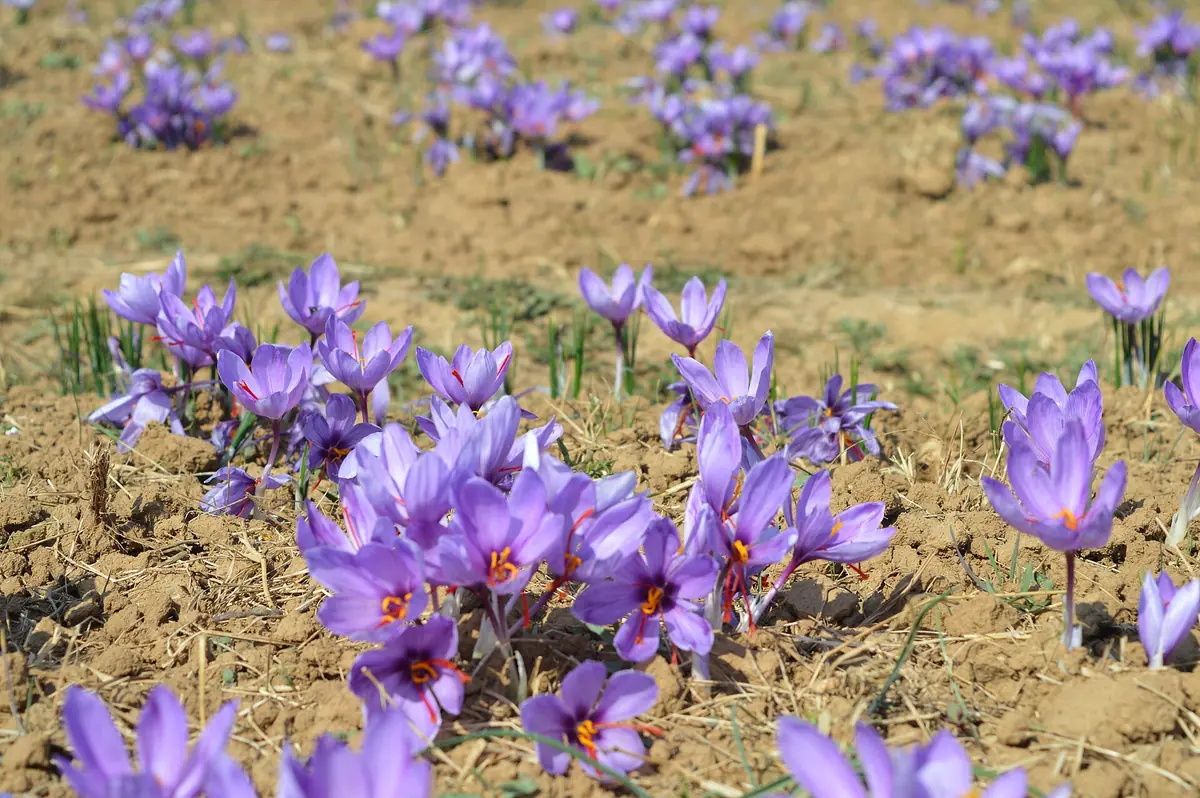
Kashmiri food is a cuisine of bakery breads, salted pink tea, rice with dishes rich in yoghurt and fennel, and mutton, with the wazwan feast at its formal peak. For most families the day starts with bread from the local baker, eaten with noon chai, the salt tea. The tourism corporation JKTDC says there were two schools of cooking, Kashmiri Pandit and Kashmiri Muslim, one marked by asafoetida and curd, the other by onions and garlic. Vegetarians have more choice than the wazwan suggests: Incredible India lists ten vegetarian dishes, from haak greens to nadru, lotus stem. Some foods are seasonal: harissa is a winter breakfast, and Pampore’s saffron flowers in late October.
In this guide12 sections
- What is Kashmiri food?
- What do Kashmiris eat for breakfast?
- Noon chai and kahwa: Kashmir’s two teas
- Vegetarian Kashmiri food
- Kashmiri Pandit cuisine
- Wazwan, the Kashmiri feast
- Kashmiri street food and snacks
- Seasonal food: harissa, nadru and saffron
- Kashmiri spices and saffron
- Kashmiri food for vegetarians and special diets
- Where to find Kashmiri food
- Kashmiri food questions
At a glance
- Breakfast
- Bakery bread with noon chai Sahapedia
- Noon chai
- Pink tea made with milk and salt
- Kahwa
- Green tea with saffron, cinnamon, cardamom and almonds
- Vegetarian?
- Yes: haak, nadru, chaman, dum olav, rajma
- Winter dish
- Harissa, from autumn dated reports below
- Saffron
- GI-registered “Kashmir Saffron”, certificate of 1 May 2020
- The feast
- Wazwan its own guide
What is Kashmiri food?
“Kashmiri food that we have today in the restaurants has evolved over the years,” says JKTDC, the J&K Tourism Development Corporation. It is “highly influenced by the traditional food of the Kashmiri pundits” and has taken on “features of the cooking style adopted in Central Asia, Persia and Afghanistan”. It “makes an extensive use of turmeric and yoghurt”.
JKTDC says there were “two great schools of culinary craftsmanship in Kashmir, namely those of Kashmiri Pandits and Kashmiri Muslims”, the first marked by heeng (asafoetida) and curd, the second by onions and garlic. Both are covered below, with the breads and teas that everyone shares.
What do Kashmiris eat for breakfast?
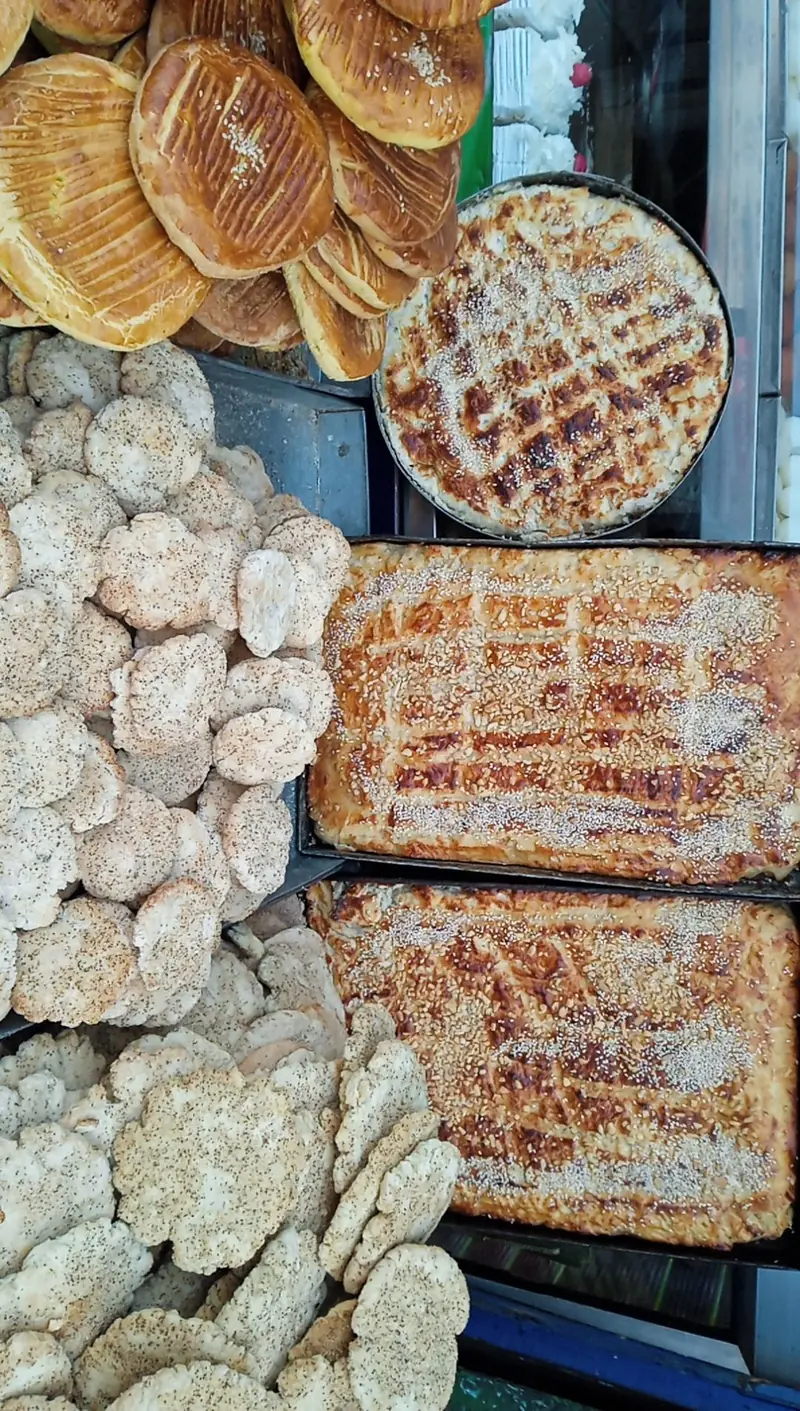
Bread and tea. For “any Kashmiri”, the day “is incomplete without a breakfast of hot bread”, Mayank Soni writes on Sahapedia, and in a second Sahapedia essay architect Taha Mughal writes that for most families “a morning without a visit to the kandur is unthinkable”.
The kandur is the traditional baker, who bakes in a clay tandoor. “Every locality has their own kandurwan”, or bakery, often more than one, and “the first items to be fired on the tandoor are girdas and lavasas”, Soni writes. Around a dozen breads are popular in Srinagar. These are the ones you will meet most:
| Bread | What it is | Eaten with |
|---|---|---|
| Girda (tschot) | A medium round bread of refined flour “kneaded with milk and salt”, dented by the baker’s fingertips | Noon chai and butter at breakfast |
| Lavasa | A thin everyday bread “similar to the naan”, soft or crisp | Wrapped round barbecued meat or chickpeas |
| Tsochvor (tilvor) | A ring like a bagel, slightly hard, with sesame seeds | A late-afternoon snack with butter or jam, or dunked in noon chai |
| Kulcha | Sweet, made with ghee, or savoury with a peanut or almond on top | Sweet kulcha with noon chai; savoury at weddings and Eid |
| Bakarkhani | Layered like puff pastry, coated with ghee and baked crisp | Kahwa; sent to in-laws at births and engagements |
| Sheermal | Mildly sweet; Pampore’s is “famous throughout the valley” | Kahwa |
| Roth | A sweet, sponge-like bread with dry fruits | Kahwa, at engagements, weddings and births |
From Sahapedia’s two essays on Kashmir’s bakers. Sahapedia says sheermal is made with “date-flavoured milk”; Incredible India describes “maida flour, milk, saffron, and yeast” and a “strong saffron flavor”. Spellings vary: tschot, girde, lawasa, tsochwor, telvor.
Other towns have their own breads: “Baramulla is known for namkeen kulcha, Pampore is famous for sheermal, Sophian for krip and Anantnag for katlam,” Soni writes. In villages, he adds, flat breads of corn flour (makai tschot) and rice flour (tomla tschot) are made on a griddle, and aab tschot is a fermented rice pancake “savoured with nun chai”.
Noon chai and kahwa: Kashmir’s two teas
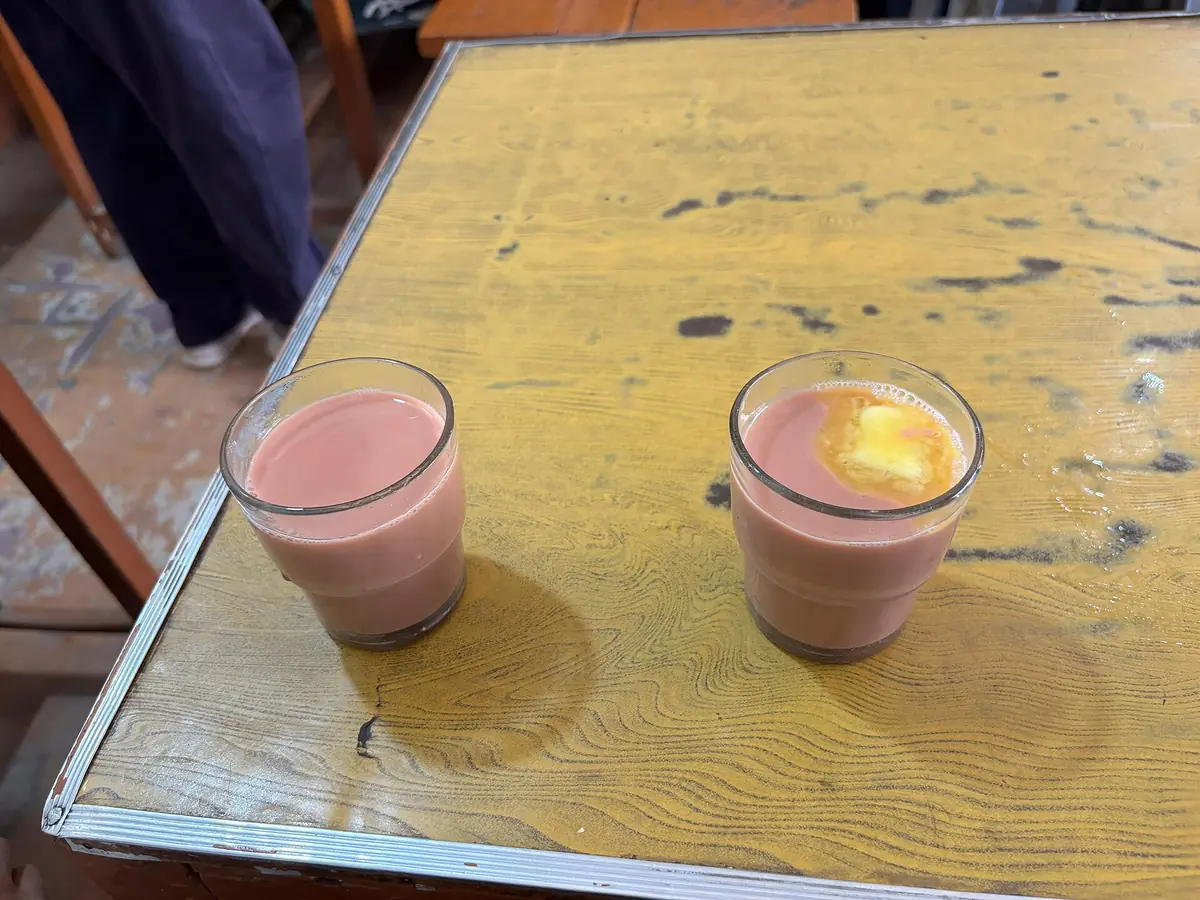
Noon chai, the pink salt tea
- Also called “sheer chai, gulabi chai, Kashmiri tea or pink tea”, says the Budgam district administration, which describes it made “with gunpowder tea, milk and baking soda” and “pink in colour”.
- “Noon” means salt, says Incredible India, and its recipe adds dry fruits such as pistachios and almonds. Sahapedia says it “is made with milk, butter and salt”.
- It goes with the thicker breads: tsochwor and kulcha, according to Sahapedia.
Kahwa, the saffron green tea
- Green tea with “cardamom, cinnamon, saffron, and almonds”, in Incredible India’s words, which says it is “commonly known as Moghul Chai in the Valley”.
- It “was traditionally prepared in a brass kettle known as samovar”, with hot coal in a central cavity, says the Budgam district site; its recipe sweetens the tea with honey.
- It is “slightly sweet and is best served with lighter breads like bakerkhani and sheermal”, Sahapedia writes.
Wazwan ends with kahwa, “a warm conclusion to a Kashmiri feast”, Sahapedia notes.
Vegetarian Kashmiri food
Kashmiri cooking is famous for mutton, but vegetarians are not left out. Incredible India’s list of vegetarian dishes to try in Srinagar says they “draw inspiration from the culinary practices of the Kashmiri Pandit community”. Its dishes, in its own descriptions:
| Dish | What it is | Worth knowing |
|---|---|---|
| Haak | Collard greens cooked with mustard oil, green chilli, asafoetida and ver masala | Also made with kohlrabi, radish or dandelion greens |
| Nadru yakhni | Lotus stem in a yoghurt sauce with fennel, ginger powder and garam masala | Served with rice |
| Lyodur tschaman | Paneer in a turmeric-yellow yoghurt gravy | Lyodur means yellow, tschaman paneer |
| Chok wangun | Fried aubergine in a tangy tamarind gravy | No tomatoes, onions or garlic |
| Al yakhni | Bottle gourd in a yoghurt gravy with fennel and dry ginger | Bottle gourd is “the quintessential summer vegetable” |
| Dum olav | Fried potatoes in fennel, ginger, cardamom, Kashmiri chilli and yoghurt | “an indispensable part of any Kashmiri Pandit festive celebration” |
| Nadru choorma | Lotus stem fritters | A snack |
| Rajma gogji | Kidney beans with turnips | No onions, tomatoes or garlic |
| Tehar | Rice coloured with turmeric, sometimes saffron | For festivals and birthdays |
Incredible India’s tenth dish is sheermal, the bread in the table above. Sahapedia’s wazwan essay adds tamatar chaman (paneer in a tomato gravy), mushrooms, and nadur monje, “crispy deep-fried lotus stem fritters enjoyed as a snack”.
Nadru, the lotus stem. Nadru grows wild in Dal Lake, and harvesters wade into it in the coldest weeks of winter to pull the stems from the lakebed, Deccan Herald reported on 12 January 2026. It “typically” sold for ₹150 to ₹250 a kilogram in Srinagar’s markets, depending on quality, the same report said. The lotus has also returned to Wular Lake after nearly three decades: see the Wular Lake guide.
Kashmiri Pandit cuisine
Kashmiri Pandit cooking is a tradition of its own, and not only a vegetarian one. These are the sources’ own descriptions:
- Asafoetida and curd. JKTDC names “the abundant use of heeng (asafoetida) and curd among the Hindus” as the main difference from the Muslim kitchen. Incredible India describes the Pandit style as known for “straightforwardness, purity, and reliance on a limited selection of spices”.
- Onion and garlic. “Originally, Kashmiri Pandits avoided onions and garlics but now many of them have acquired a taste for them and include them in certain recipes as optional,” JKTDC says; it lists “the avoidance of onion and garlic in some homes” among the traits that remain. A PTI report on a 2024 Delhi food festival, published by ETV Bharat, said Pandit cooking “doesn’t use onion, garlic and tomato” and uses “yogurt, asafoetida (hing), or sometimes rice flour as its base”.
- Meat too. Kashmiri Pandits “are not averse to eating meat”, JKTDC says, and “prefer goat and that too a young one”.
- Dishes JKTDC names: kabargah, kofta, dum alu, methi chaman and firni. The PTI report describes kabargah as “mutton ribs stewed in spices and fried” and adds chaaman qaliya (“paneer cubes cooked in turmeric and milk-based curry”) and gucchi yakhni (morels in a yoghurt curry).
Wazwan, the Kashmiri feast
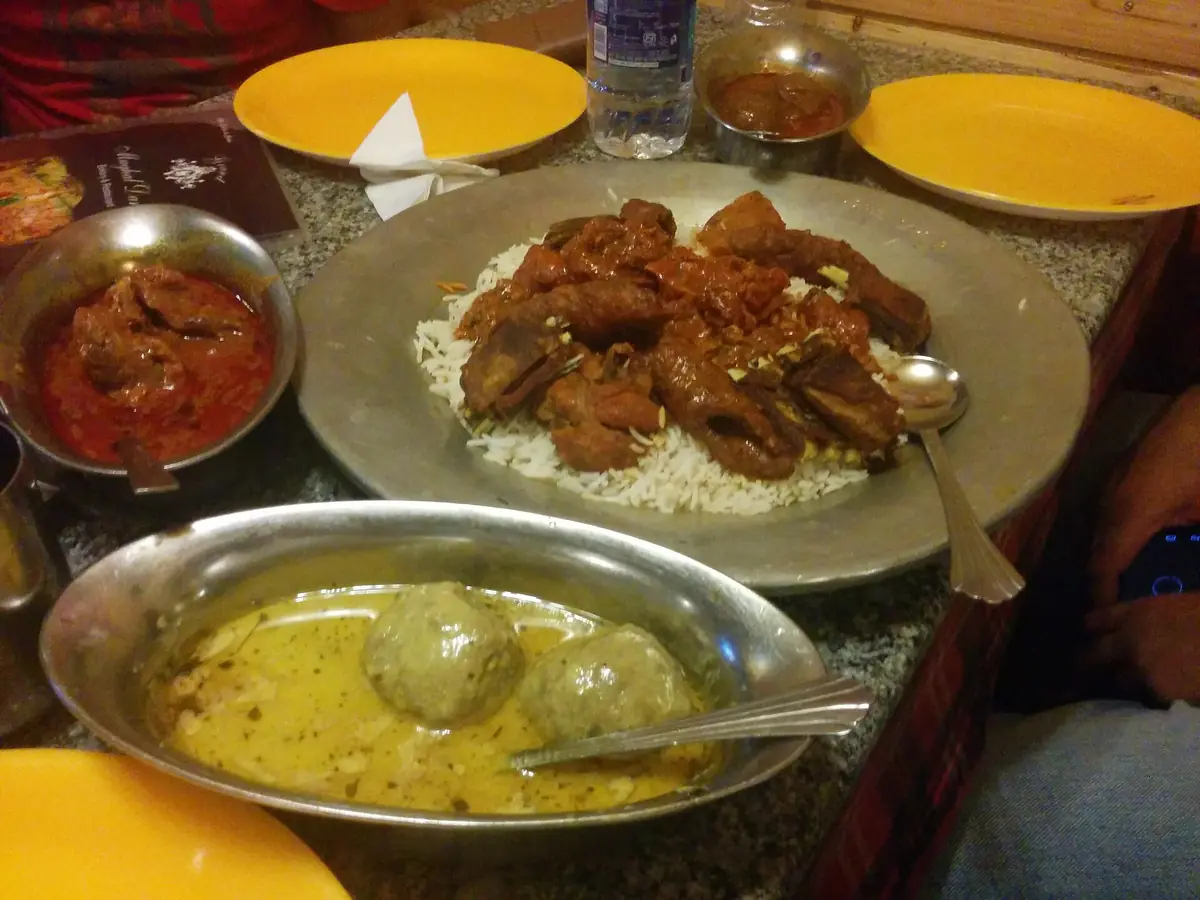
Wazwan is the formal multi-course feast of mostly mutton dishes, cooked by professional wazas and shared by four guests from one copper platter, the trami. JKTDC calls it “the traditional Kashmiri Muslim banquet”. The seven core dishes, how it is served, its few vegetarian dishes, one dated restaurant menu and the restaurants Incredible India names are all in our wazwan guide.
Kashmiri street food and snacks
- Masaal tchot: “boiled chickpeas served with bread”, Anadolu Agency reported in October 2021. A cart seller told it the dish goes with a radish chutney “mixed with fresh curd, green chili, coriander, pepper and salt”, wrapped in lavasa, and that Srinagar “has the major base for this street food”.
- Fried snacks at the shrines: near the Hazratbal shrine, Anadolu found vendors in 2021 frying lotus stem (“nadir monji”) and small fish (“monji gaade”) coated in flour, and a woman at the shrine’s main gate selling “mongh masala”, a steamed black gram dish. More on the shrine in our Hazratbal guide.
- Porathe and halwa: a bread “like a puri, but 7 times bigger”, which can weigh “as much as 1kg”, is “very popular outside Sufi shrines across the valley” and served with sweet halwa, Sahapedia writes.
- Barbecue in lavasa: lavasa “is also used to wrap barbecued meats and chickpeas”, according to Sahapedia.
Seasonal food: harissa, nadru and saffron
Autumn
Harissa returns as the weather cools, KNO reported in October 2023, and saffron flowers in Pampore. The GI filing for Kashmir saffron says it flowers “in second fortnight of October and continues till first week of November”, depending on temperature and moisture.
Winter
Harissa season: “not an everyday staple food in Kashmir but is eaten during winter”, ETV Bharat reported. Nadru is pulled from Dal Lake during Chillai Kalan, the harshest 40 days of winter, Deccan Herald reported in January 2026.
Summer
Incredible India calls bottle gourd, cooked as al yakhni, “the quintessential summer vegetable in Kashmir”.
When is harissa season?
Harissa is a slow-cooked dish of mutton and rice; Kashmir Despatch (KNO) adds wheat. It is cooked overnight and eaten in the early morning with bread, and sellers pour hot oil over it before serving, IANS and Kashmir Times reported. The shops are concentrated in Srinagar’s old city: ETV Bharat named Zaina Kadal, Aali Kadal, Saraf Kadal, Nawa Kadal and Fateh Kadal in December 2022, and Greater Kashmir said in November 2023 that its popularity was “extending to uptown areas like Maisuma and Rajbagh”. No season has a fixed start date. These dated reports show how it runs:
- 10 Jan 2015Locals “relish” harissa “for nearly five months in a year”, IANS reported in Khaleej Times.
- 4 Dec 2022Harissa “is not an everyday staple food in Kashmir but is eaten during winter”, ETV Bharat reported.
- 9 Oct 2023As “the golden hues of autumn” arrived, people were “savouring steaming bowls of Harissa”, KNO reported in Kashmir Despatch.
- 13 Nov 2023Demand was so high that “by 10 am, obtaining a plate of Harissa becomes nearly impossible as many shops have already sold out”, Greater Kashmir reported.
- 15 Jan 2025One maker starts cooking at noon: “By the time of the Fajr (early morning) prayer, it is ready to serve our customers,” he told Kashmir Times.
We found no report on the 2026–27 harissa season by 24 October 2026. How harissa reached Kashmir is told differently: KNO credits Mir Syed Ali Hamdani in the 14th century, Kashmir Times credits Mir Syed Shah Qasim Haqqani in the 16th, and Greater Kashmir says it came “during the Mughal era” but that its “exact origin and entry date into the Valley remain unknown”. For the winter itself, see Kashmir in winter.
Kashmiri spices and saffron
You will taste the same few flavours again and again. These are named in the sources above:
| Spice | Where you meet it | Source |
|---|---|---|
| Fennel and dry ginger | Nadru yakhni, al yakhni, lyodur tschaman, dum olav | Incredible India |
| Kashmiri red chilli | Dum olav (“visually striking”), rogan josh | Incredible India, PTI |
| Asafoetida (hing) | Pandit cooking, haak, lyodur tschaman | JKTDC, Incredible India |
| Turmeric | Lyodur tschaman, tehar; “extensive use” overall | Incredible India, JKTDC |
| Ver masala | Haak | Incredible India |
| Pran (shallot) | Wazwan; “grown in Kashmir” | Sahapedia |
| Saffron | Kahwa, sheermal, sometimes tehar | Incredible India, Sahapedia |
Kashmir saffron has a GI tag. India’s Geographical Indications registry lists “Kashmir Saffron” as registered:
| On the GI registry | Entry |
|---|---|
| Application | 635, “Kashmir Saffron”, class 30 |
| Applicant | The Agriculture Production Department J & K |
| Filed | 3 December 2018 |
| Certificate | No. 366, dated 1 May 2020 |
| Valid until | 2 December 2028 |
Read on the IP India GI registry, 24 October 2026.
The GI filing, published in GI Journal No. 127 on 1 January 2020, says the saffron is “cultivated and harvested in the Karewas (high lands) of Jammu and Kashmir”. It names Pampore, “about 25 km south-east of Srinagar”, and Kishtwar, with a few places in Budgam and Srinagar districts. It describes three kinds: lachha (whole dried stigmas), mongra (only the red part, “considered of the highest quality”) and guchhi (stigmas tied in bundles with thread).
Kashmiri food for vegetarians and special diets
These points come from the dish descriptions above:
- Vegetarian: wazwan is “almost all” meat, says the Budgam district site, but haak, nadru, chaman, dum olav, chok wangun and rajma gogji are on Incredible India’s vegetarian list. Waza palak, a wazwan spinach dish, contains mutton balls (see the wazwan guide).
- No onion or garlic: Incredible India describes chok wangun and rajma gogji as made without onions, tomatoes or garlic, and JKTDC says some Pandit homes still avoid onion and garlic.
- Dairy: yoghurt is the base of yakhni dishes such as nadru and al yakhni, and of lyodur tschaman; noon chai is made with milk (and butter, Sahapedia says), and girda is kneaded with milk.
- Wheat: girda and lavasa are made from maida (refined flour) dough, Sahapedia says, and sheermal from maida flour, says Incredible India.
- Nuts: Incredible India lists almonds among kahwa’s ingredients, and pistachios and almonds in noon chai.
- Salt, not sugar: noon chai is a salted tea; kahwa is “slightly sweet”, says Sahapedia.
Where to find Kashmiri food
We do not rank restaurants or eateries. These are the food places that official sources name:
The floating vegetable market, Dal Lake
Incredible India’s Srinagar page suggests “the early morning floating vegetable market near Nehru Park”. The official boat fares on the lake are in Dal Lake shikara prices.
Srinagar’s old city bazaars
The old city’s bazaars “sell everything from Kashmiri handicrafts, and Pashmina shawls, to traditional spices and dry fruits”, says Incredible India.
Pampore’s saffron fields
Saffron is grown “mainly on the Karewa plateaus of Pampore”, Greater Kashmir reports. The flowers come from the second half of October to the first week of November, according to the GI filing.
Wazwan restaurants
Incredible India names four restaurants for wazwan, three in Srinagar and one in Gulmarg. They are listed, with one dated menu, in our wazwan guide.
Pampore is an estimated 30–45 minutes by road from Srinagar, according to the Go Kashmir app as of 24 October 2026. To fit the saffron fields into a Srinagar day, the Go Kashmir app has a place card for Pampore with its season and road time from Srinagar. For the rest of the city, see places to visit in Srinagar.
Kashmiri food questions
What is the famous food of Kashmir?
Wazwan, the multi-course mutton feast, whose dishes include rogan josh, rista and gushtaba; Incredible India calls rogan josh wazwan’s “signature dish”. Day to day, Kashmiris eat bakery breads such as girda and lavasa, drink noon chai and kahwa, and cook vegetarian dishes such as haak, nadru yakhni and dum olav.
What do Kashmiris eat for breakfast?
Bread from the local kandur, such as girda or lavasa, with noon chai and butter, according to Sahapedia. In winter, harissa is “the popular choice of morning food”, ETV Bharat reported in 2022.
Is there vegetarian Kashmiri food?
Yes. Incredible India lists ten vegetarian dishes, including haak, nadru yakhni, lyodur tschaman, chok wangun, dum olav and rajma gogji. Wazwan is the exception: almost all of it is meat.
What is noon chai made of?
Gunpowder tea, milk and baking soda, says the Budgam district site; Sahapedia says it is made with milk, butter and salt. “Noon” means salt, and the tea is pink.
When is harissa available in Kashmir?
In the cold months. Dated reports describe it returning to Srinagar’s shops in autumn (October 2023) and being eaten through winter; IANS reported in 2015 that locals eat it “for nearly five months in a year”. In November 2023 many shops had sold out by 10 am, Greater Kashmir reported.
Does Kashmiri Pandit food use onion and garlic?
Traditionally not: it relies on asafoetida and curd. JKTDC says many Pandit families now use onion and garlic in some recipes, while some homes still avoid them.
Sources
- J&K Tourism Development Corporation (JKTDC), Cuisines of Kashmir (undated). Read 24 Oct 2026.
- Ministry of Tourism, Incredible India, 10 best vegetarian dishes to try in Srinagar (undated). Read 24 Oct 2026.
- Ministry of Tourism, Incredible India, Srinagar and Kashmir: a quick and handy travel guide (both undated). Read 24 Oct 2026.
- Budgam district administration, Culinary Delights: Noon chai, Kashmiri kahwa and Wazwan. Read 24 Oct 2026.
- Sahapedia, Mayank Soni, Kandurs of Srinagar: breadmaking in Kashmir Valley (undated). Read 24 Oct 2026.
- Sahapedia, Taha Mughal, Baking with Baraka (undated; its notes cite pages accessed in March 2025). Read 24 Oct 2026.
- Sahapedia, Raja Muzaffar Bhat, Wazwan: a culinary legacy (undated). Read 24 Oct 2026.
- Greater Kashmir, Kashmiri bread prices double, 26 Dec 2024, and Div Com Kashmir holds meeting with Nanwai Association, 27 Dec 2024.
- Kashmir Life, Kashmiri ‘Kandur Tchout’ prices temporarily revised, 27 Dec 2024.
- ETV Bharat (PTI), Poshmaal festival celebrates authentic Kashmiri Pandit cuisine, 17 Mar 2024.
- Anadolu Agency, World Food Day report on Kashmir’s street foods, 16 Oct 2021.
- Deccan Herald, In Kashmir’s freezing Dal Lake, lotus stem harvesters hold on to vanishing way of life, 12 Jan 2026.
- Khaleej Times (IANS), Harisa: king of Kashmir’s winter cuisine, 10 Jan 2015.
- ETV Bharat, In winter, Kashmiris savour harissa, 4 Dec 2022.
- Kashmir Despatch (KNO), Harissa: a delicacy returns to Valley as autumn signals winter’s arrival, 9 Oct 2023.
- Greater Kashmir, Harissa sales sizzle as winter chill sets in, 13 Nov 2023.
- Kashmir Times, Harisa: winter comfort of Kashmir, 15 Jan 2025.
- Intellectual Property India, GI registry, application 635, Kashmir Saffron, and its GI Journal No. 127 copy (1 Jan 2020) filed there. Read 24 Oct 2026.
- Greater Kashmir, Saffron growers in Kashmir brace for harvest after poor season, 23 Oct 2026.
- Go Kashmir app, estimated road time from Srinagar to Pampore, 24 Oct 2026.
We write from published sources and do not claim personal visits. How we check facts.
Read next
Keep planning
 Culture & foodWazwan: Kashmir’s feast, its dishes and how it is servedThe seven core dishes, the copper trami shared by four, table customs, prices and where to try it.
 Destination guidePlaces to visit in Srinagar: lakes, gardens and the old cityDal and Nigeen lakes, the Mughal gardens, the old city and what’s closed.
 Weather & seasonsKashmir in winter: snow, cold, roads and what stays openBelow-freezing nights, snow on no fixed date, and the roads and flights that stop.


